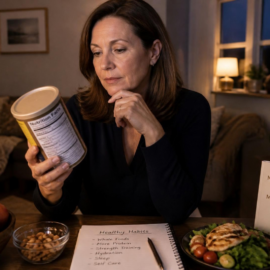

You catch your reflection in a window you weren’t expecting, and for half a second you don’t recognize the woman looking back.
For a lot of women in perimenopause and menopause, the thought is startlingly simple: I don’t feel like myself anymore.
Maybe your patience has changed. Your confidence feels different. Your energy, focus, body, relationships, or tolerance for things you once accepted no longer feel familiar. You may even catch yourself wondering, “Why do I feel like a different person in menopause?”
You call it being lost.
I think there may be a more accurate word.
Unfamiliar.
Lost means there is a known place you wandered away from. Unfamiliar means you may be standing somewhere new, before your sense of self has had time to catch up.
Why You Don’t Feel Like Yourself in Menopause
There is research behind this feeling, and I think women deserve to know that.
A 2024 study published in Menopause, the journal of The Menopause Society, looked specifically at women in the late reproductive stage and menopausal transition who said they were “not feeling like myself.” In the study, 63.3% of participants reported feeling that way at least half of the time during the previous three months.
The feeling was associated with a cluster of experiences that will sound familiar to many midlife women: fatigue, feeling overwhelmed or less able to cope, low mood, increased nervousness, irritability, trouble concentrating, difficulty making decisions, forgetfulness, tearfulness, and worrying more. When the researchers grouped symptoms together, “not feeling like myself” was most strongly associated with anxiety or vigilance, fatigue and pain, brain fog, sexual symptoms, and volatile mood symptoms.
That does not mean every change in mood, identity, or energy is caused by menopause. It does mean this phrase is not rare, dramatic, or something women invented because they are failing at midlife. There is a real pattern worth paying attention to.
Sometimes the hardest part is not the symptom itself. It is the unfamiliarity of your own response. You used to recover faster. You used to tolerate more. You used to know what would make you feel steady. Now the old instructions do not seem to fit.
If you want the broader picture of how sleep, blood sugar, stress, strength, and other midlife changes can interact, start with Understanding Menopause: Where to Start.
Why “Lost” May Be the Wrong Word
Lost implies a self you had fully mapped and can no longer find your way back to. It turns the task into retrieval: retrace your steps, fix what changed, get back to the woman you were.
But that may be the wrong assignment.
Midlife is a transition on more than one level. Hormones may be changing, but so are responsibilities, relationships, bodies, careers, family roles, priorities, griefs, ambitions, and the amount of emotional labor you are willing to keep carrying.
Sometimes what feels like “I have lost myself” is partly the shock of realizing the old version of you no longer fits the life you are living.
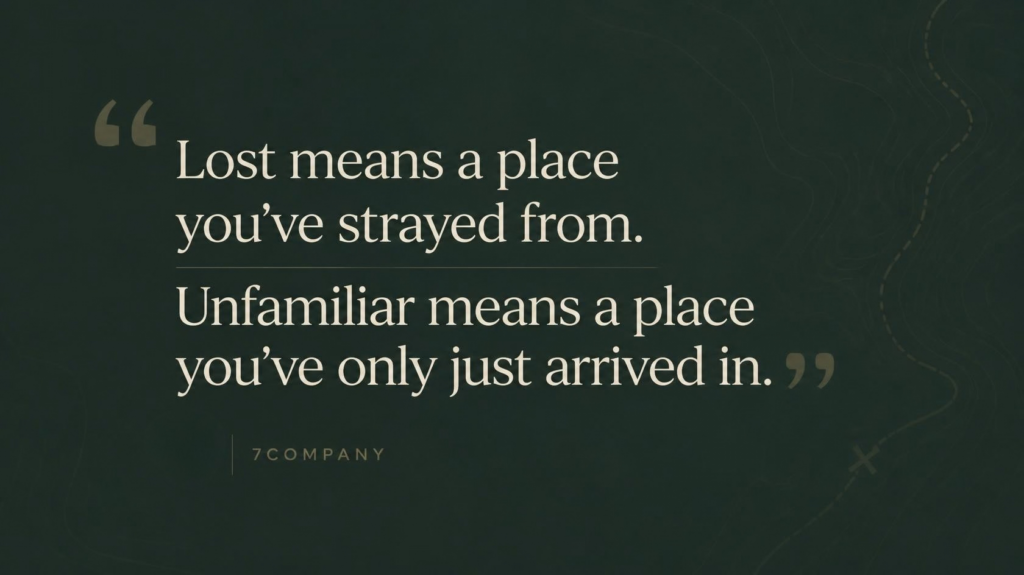
“Lost means a place you’ve strayed from. Unfamiliar means a place you’ve only just arrived in.”
What a Midlife Identity Shift Can Feel Like
An identity shift does not always arrive as some dramatic reinvention. Most of the time it is quieter than that.
“I don’t have the patience for this anymore.”
“The things that used to motivate me don’t matter as much.”
“I need more quiet than I used to.”
“I don’t want to keep saying yes just to keep everyone else comfortable.”
“I miss feeling interested in my own life.”
Those sentences can feel unsettling because they challenge the identity you built around being capable, agreeable, productive, needed, or endlessly adaptable.
But changing your limits does not automatically mean you have changed for the worse. Sometimes it means your old way of operating is becoming too expensive.
For some women, nervous system overload is part of the picture. If you feel more reactive, overstimulated, tired but unable to fully relax, or as if your buffer has disappeared, read Stress and the Nervous System in Midlife: Where to Start.
Lost vs. Unfamiliar: Why the Difference Matters
If you believe you are lost, you naturally start searching backward. You compare yourself with who you were at 35 or 45. You ask why you cannot handle what you used to handle. You try to recreate an old body, an old schedule, an old level of energy, an old tolerance.
There is no finish line to that search because life did not stand still.
If you are unfamiliar instead, the task changes. You do not need retrieval. You need introduction.
You get curious about the woman who is here now.
What gives her energy? What drains it? What does she need more of? What is she no longer willing to trade away? What feels like relief? What feels like truth?
That is a very different way to move through midlife. Less fixing. More listening.
How to Get Reacquainted With Yourself in Midlife
Do not make this another self-improvement project. You do not need a 30-day reinvention plan or a color-coded binder for becoming yourself.
Start smaller.
Notice what feels different without immediately trying to correct it. Pay attention to the moments when your body softens and the moments when it braces. Notice what you keep saying you miss. Notice what you keep doing out of obligation long after it stopped feeling like a choice.
Then ask one useful question: What needs support first?
That is the reason I use the Menopause Map. When everything feels tangled, trying to fix everything at once creates more noise. It is easier to find your footing when you identify the floor that is asking for attention first: Sleep, Food and Blood Sugar, Strength, Stress, or Joy.
If fatigue is the loudest thing right now, you may also want to read Why Am I So Tired in Midlife? The 5 Biggest Energy Drains and How to Fix Them.
When Not Feeling Like Yourself Needs More Support
There is an important line here.
A reframe can be useful, but it should never be used to explain away symptoms that need professional care. If this sense of disconnection is persistent, worsening, interfering with daily life, or accompanied by significant anxiety, depression, panic, severe sleep disruption, or other concerning symptoms, talk with a qualified healthcare professional.
Midlife can be a season of change, but “it’s probably menopause” should not become a reason to dismiss something that deserves evaluation.
If you ever have thoughts of harming yourself or feel unsafe, seek immediate help. In the United States, call or text 988 for the Suicide & Crisis Lifeline.
Where to Start
If you do not feel like yourself but cannot quite name what has changed, do not try to solve your whole life today.
Find the first floor.
The free Menopause Assessment takes about two minutes and helps you identify which of the five floors may need support first: Sleep, Food and Blood Sugar, Strength, Stress, or Joy.
Take the free Menopause Assessment →Start here
You do not have to go backward to become yourself again. You may need to get acquainted with the woman who is here now.
| Educational disclaimer: This article is for educational purposes only and is not medical advice, diagnosis, or treatment. Consult a qualified healthcare professional for medical concerns. |
Sources & References for the Article
Coslov N, Richardson MK, Woods NF. “Not feeling like myself” in perimenopause — what does it mean? Observations from the Women Living Better survey. Menopause. 2024;31(5):390–398. PubMed | Full text (PMC)