

If you feel like your energy has changed in midlife, you are not imagining it.
I hear this all the time from women who are doing their best, holding a lot, and wondering why their body does not respond the way it used to.
“I used to have more energy.”
“I do not feel like myself.”
“I am doing the same things, but they are not working anymore.”
The usual advice is to push harder, sleep more, exercise more, eat cleaner, or get more disciplined. Sometimes those pieces matter. But in midlife, that advice can miss the bigger issue.
Your energy may not be low because you are lazy. Your energy may be low because it is leaking all day long.
That is why I do not start with the question, “How do I get more energy?” I start with a better one:
Where is your energy being lost?
Why you feel low energy in midlife: quick answer
Many women feel tired in midlife because hormonal changes can affect sleep, blood sugar, stress response, and muscle mass. The most common energy drains include poor sleep quality, unstable blood sugar, chronic stress, low muscle mass, and living beyond your physical or emotional capacity. Addressing these areas can help restore steadier, more sustainable energy.
Take the Menopause Assessment to identify where you are on the map.
IMAGE PLACEMENT: Place Image 1 here as the hero image. Use the full-width horizontal crop.
Why energy changes in midlife
Midlife changes the math. Habits that used to work may not support you the same way now. That does not mean you are broken. It means your body is asking for a more honest kind of support.
During perimenopause and menopause, changes in estrogen and other hormones can affect sleep, mood, hot flashes, night sweats, and overall daily function. These shifts can make energy feel less predictable and recovery feel slower.
The National Institute on Aging notes that menopause-related hot flashes and mood changes can disrupt sleep, and poor sleep can affect mood, memory, and daytime safety. The Office on Women’s Health also lists sleep problems, mood changes, hot flashes, and not feeling like your usual self among common menopause symptoms.
This is why I do not love “just push through” advice for midlife women. If your body is already under-supported, pushing harder usually widens the gap.
Low energy in midlife is often not a discipline problem. It is a support problem.
The 5 biggest energy drains in midlife
1. Blood sugar instability
This is one of the first places I look because it is so common and so easy to miss.
Blood sugar instability can look like skipping breakfast, having coffee instead of food, eating lightly all day, crashing in the afternoon, then feeling hungrier or snackier at night. Many women think this is a willpower issue. I usually see it as an unstable fuel issue.
The Harvard T.H. Chan School of Public Health explains that high-glycemic foods can be digested quickly and cause larger blood sugar fluctuations, while lower-glycemic foods tend to create a slower, steadier rise. Harvard Health also notes that sugary foods can create a short energy burst followed by a crash.
Common signs this may be your leak:
- You need caffeine to feel functional.
- You crash in the afternoon.
- You feel shaky, foggy, irritable, or snacky between meals.
- You eat too little early in the day and more at night.
- You confuse cravings with lack of discipline.
What to try first:
- Eat protein earlier in the day.
- Build meals around protein, fiber, and healthy fat.
- Stop using coffee as a meal replacement.
- Avoid long gaps without food if they lead to crashes.
- Notice when your cravings happen instead of judging them.
If your energy crashes every afternoon, I would not start with your willpower. I would start with your fuel.
2. Poor sleep quality
A lot of women tell me they sleep, but they do not wake restored. That distinction matters.
You can be in bed for enough hours and still not be getting the depth of recovery your body needs. Midlife sleep can be disrupted by hot flashes, night sweats, stress, alcohol, late eating, inconsistent routines, or a nervous system that never fully downshifts.
The National Institute on Aging recommends sleep-supportive habits such as keeping the bedroom cool, maintaining a regular sleep schedule, avoiding large meals near bedtime, and creating a relaxing bedtime routine.
Common signs this may be your leak:
- You wake up tired even after a full night in bed.
- You wake between 2 and 4 a.m.
- You rely on wine or screens to wind down.
- You go from full speed to pillow with no transition.
- You feel more emotional or foggy after poor sleep.
What to try first:
- Create a 20-minute wind-down routine.
- Keep your room cooler if night heat is an issue.
- Reduce alcohol close to bedtime.
- Avoid large meals right before bed.
- Keep wake and sleep times as consistent as possible.
You cannot demand deep rest from a body that has been bracing all day.
3. Chronic stress and nervous system overload
This is one of the most overlooked energy drains because many women do not call it stress. They call it life.
But if your body is constantly scanning, anticipating, managing, caregiving, overthinking, pleasing, or bracing, that takes energy. A lot of energy.
You may not feel “stressed” in a dramatic way. You may simply feel wired, impatient, flat, numb, tense, or unable to truly relax.
The Cleveland Clinic explains that stress can affect multiple body systems, including sleep, digestion, immune function, muscles, and mood. In other words, stress is not just in your head. It is a whole-body load.
Common signs this may be your leak:
- You feel tired but cannot relax.
- Your jaw, shoulders, or chest feel tight.
- You wake up already tense.
- You feel responsible for everyone else’s emotions.
- Quiet feels uncomfortable, so you stay busy.
What to try first:
- Add two or three short pauses during the day.
- Practice slow breathing for one to three minutes.
- Step outside for natural light and a nervous system reset.
- Reduce one unnecessary input: noise, scrolling, multitasking, or overcommitting.
- Notice where you are performing “fine” instead of telling the truth.
A dysregulated nervous system can drain more energy than a full calendar.
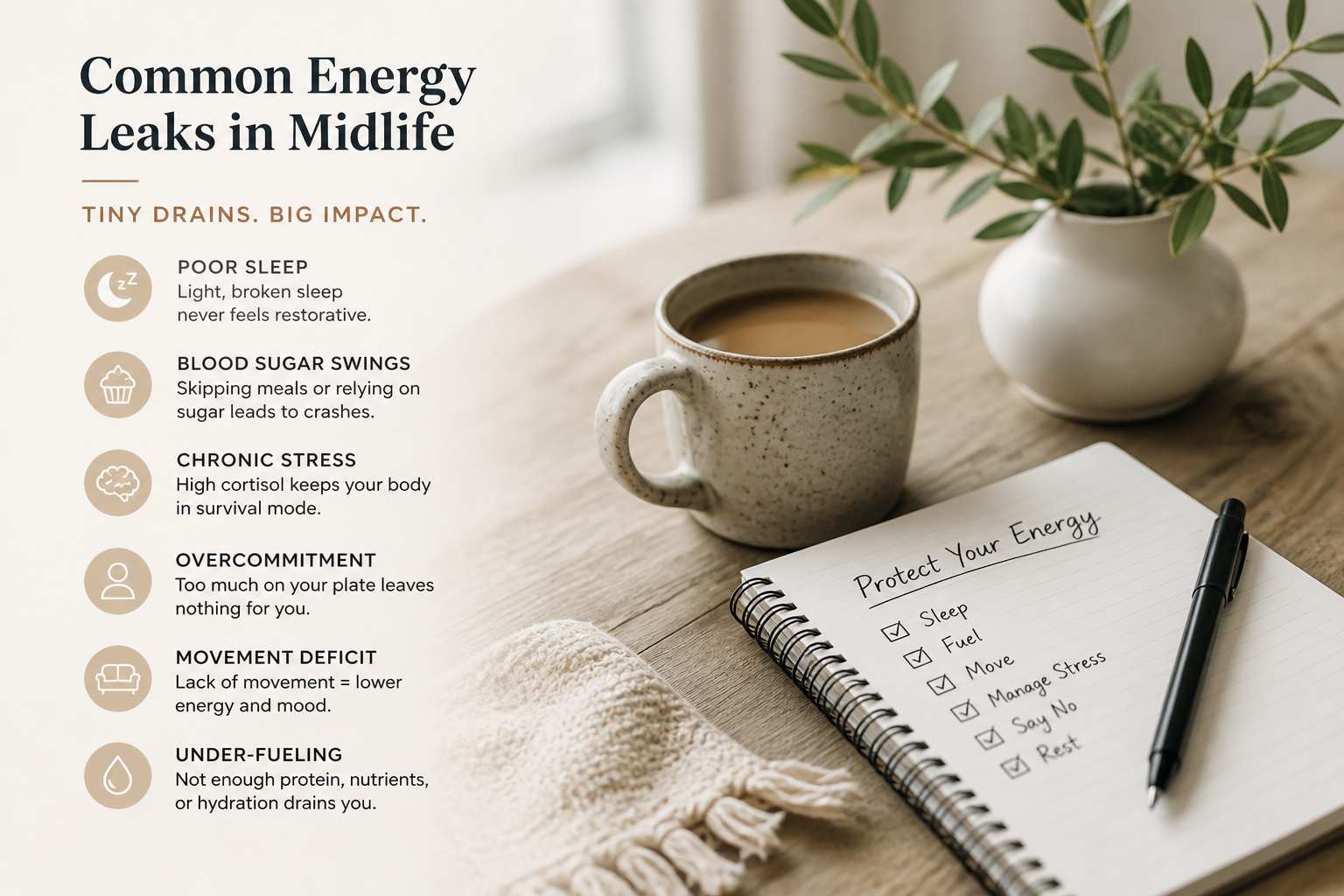
4. Low muscle mass
Muscle is not just about looking toned. Muscle is part of your energy system.
As we age, we naturally lose muscle unless we actively work to preserve it. That matters because muscle supports metabolism, blood sugar regulation, strength, balance, bone health, and daily capacity.
When muscle declines, life can start to feel heavier. Stairs feel harder. Groceries feel heavier. Recovery feels slower. The body feels less powerful.
The Mayo Clinic notes that strength training can help manage weight, increase metabolism, strengthen bones, and improve quality of life. Mayo Clinic also explains that aging is associated with muscle loss, which can slow calorie burning over time.
Common signs this may be your leak:
- You walk, but you do not strength train.
- Your body feels softer or weaker than it used to.
- You avoid lifting because you think it has to be intense.
- You feel tired from basic daily tasks.
- You are not eating enough protein to support muscle.
What to try first:
- Add resistance training two to three times per week.
- Start with bodyweight, bands, or light dumbbells if you are new.
- Prioritize protein at meals.
- Track consistency, not perfection.
- Build strength slowly so your body trusts the process.
Strength is not optional in midlife. It is part of your energy system.
5. Living beyond your capacity
This one is harder to measure, but it may be the most honest.
Sometimes fatigue comes from doing too much with too little recovery, too little support, and too little truth. Many women in midlife are carrying careers, families, aging parents, relationships, invisible emotional labor, and the pressure to stay pleasant while depleted.
If your life is constantly asking more than your current capacity can support, your body will eventually tell the truth.
Common signs this may be your leak:
- You keep going even when your body is asking you to stop.
- You say yes because it keeps the peace.
- You feel resentful, flat, or disconnected from yourself.
- You are productive but not replenished.
- You are trying to fix depletion with another plan instead of reducing the load.
What to try first:
- Identify one place you are over-functioning.
- Make one small boundary clearer.
- Remove one unnecessary obligation if possible.
- Schedule recovery before you are empty.
- Ask what kind of support would actually change your day.
Burnout is not always from doing too much. Sometimes it is from doing too much without enough support, recovery, or truth.
How to restore energy in midlife
The answer is not to fix everything at once. That is where many women get overwhelmed.
Choose one leak. The most obvious one. The one your body keeps pointing to. The one that would make the biggest difference if it became steadier.
Maybe your first step is protein at breakfast. Maybe it is a real wind-down routine. Maybe it is two short strength sessions a week. Maybe it is one honest boundary. Maybe it is pausing before you say yes.
Energy usually does not return because you force it. It returns because you stop losing so much of it.
Where to start
If you are not sure where your energy is leaking, start with the Menopause Assessment. It is designed to help you see which area needs support first: sleep, food and blood sugar, stress and nervous system, muscle and strength, or joy span.
Take the Menopause Assessment
If you want a simple framework for understanding the bigger picture, you can also explore The Menopause Map, my practical way of helping midlife women identify what needs support without turning their life into another impossible project.
Get support inside The Menopause Map
You do not need a harsher plan. You need a better map. And you do not have to build it alone.
Inside The Menopause Map community, we make this practical, doable, and less lonely. We look at the foundations that matter most in midlife and focus on the next small step that actually fits your life.
Join The Menopause Map
Final thoughts
Low energy in midlife is common, but that does not mean you have to accept it as your new normal.
Fatigue is often information. It can point to sleep that is not restoring you, fuel that is not steady, stress that has become too constant, muscle that needs rebuilding, or a life that is asking too much without enough support.
You are not lazy. You are not failing. Your body may simply be asking for a different kind of care now.
Find the leak. Support the floor. Rebuild from there.
Midlife energy is not something you chase. It is something you protect.
Frequently Asked Questions About Low Energy in Midlife
Why am I so tired in midlife?
Low energy in midlife is often connected to changes in sleep quality, blood sugar regulation, stress load, muscle mass, and hormonal shifts during perimenopause or menopause. It is not always a motivation problem. Often, it is a support problem.
Can menopause cause fatigue?
Yes. Menopause and perimenopause can contribute to fatigue through sleep disruption, hot flashes, night sweats, mood changes, and changes in recovery. Fatigue can also come from lifestyle load, stress, nutrition, and muscle loss.
What helps with midlife fatigue?
The best place to start is with the basics: steady protein, balanced meals, better sleep routines, strength training, stress reduction, and identifying where your body is most depleted.
Why do I crash in the afternoon?
Afternoon crashes are often linked to unstable blood sugar, not eating enough protein earlier in the day, poor sleep, dehydration, stress, or relying too heavily on caffeine.
Is low energy after 40 normal?
It is common, but it is not something you should ignore. Low energy is often a signal that something needs support, especially sleep, fuel, stress recovery, muscle, or overall life capacity.
When should I talk to a medical provider about fatigue?
If fatigue is severe, sudden, persistent, or accompanied by symptoms such as chest pain, shortness of breath, unexplained weight loss, heavy bleeding, dizziness, depression, or significant changes in sleep or mood, talk with a qualified healthcare provider. This article is educational and is not a substitute for medical care.