
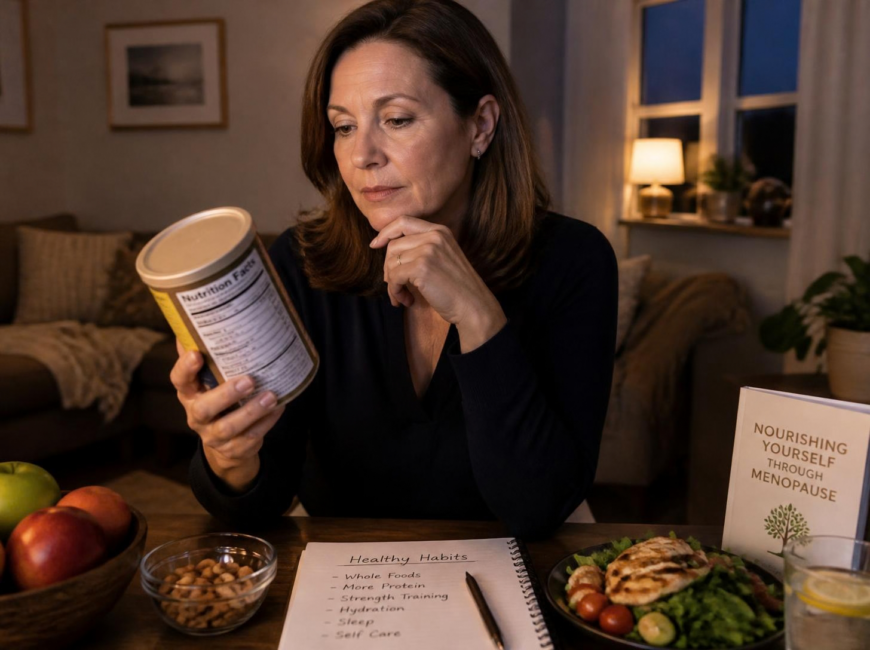
Calorie counting stops working in menopause for a specific, physical reason, and once you understand it, the whole conversation about weight in this transition changes. The body’s insulin response, muscle mass, and fat distribution all shift during menopause, changing how the same food and the same exercise translate into actual weight. It isn’t a discipline problem. It’s a math problem, and the math genuinely changed.
I spent years coaching women through exactly this wall before I understood the mechanism myself. A woman would come in doing everything asked of her, logging meals, walking daily, and the scale simply would not move. I had no real answer beyond the usual suspects: stress, sleep, maybe an underreported snack somewhere. I did not yet have the research in front of me that explained why calorie counting stops working in menopause in a way that has nothing to do with effort.
Why Does Calorie Counting Stop Working in Menopause?
The formula most women were taught treats calories in and calories out as a fixed equation, unaffected by age. But three real variables inside that equation shift specifically during menopause. Insulin sensitivity declines. Muscle mass drops. Fat distribution moves toward the abdomen. Each change alone would matter on its own. Together, they explain why an approach that worked reliably for a woman in her thirties can stop working entirely by her fifties, with no change in her effort at all.
The Insulin Resistance Piece
A study published in the journal Menopause compared premenopausal and early postmenopausal women matched for age and body composition. Postmenopausal women showed measurably lower insulin-stimulated glucose uptake in muscle tissue. In practical terms, the same meal can produce a different metabolic response after menopause than it did before it, even when nothing else about the woman eating it has changed. This is one of the clearest, most specific reasons calorie counting stops working in menopause the way it once did.
“You were never lacking discipline. You were following math that stopped applying to your body.”
Why Muscle Mass Matters More Than Most Diets Admit
Muscle tissue accounts for a large share of resting calorie burn. As muscle mass naturally declines with age, that daily burn drops with it, independent of anything on a food label. Less muscle also means less tissue available to absorb glucose efficiently, which compounds the insulin resistance already occurring, creating a cycle that no amount of stricter counting addresses.
Does Menopause Really Change Where Fat Is Stored?
Yes. Research examining abdominal fat tissue across the menopause transition found measurable changes in fat cell structure and inflammation specific to this hormonal shift, not general aging. That’s part of why fat can redistribute toward the abdomen during menopause even when total weight hasn’t changed much at all.
The Real Cost of Staying With the Old Formula
Here is what staying with the old formula actually costs. Every month spent tightening restriction that already isn’t working is a month spent further depleting the muscle mass and metabolic flexibility a woman actually needs to address the real problem. Calorie counting stops working in menopause quietly, not with an obvious failure, which is exactly what makes the wrong explanation so easy to keep believing. It doesn’t just fail. It makes the actual mechanism harder to see and harder to fix.
What This Means for How You Approach Food Now
Understanding why calorie counting stops working in menopause doesn’t reverse the shift overnight, but it does change the target entirely. Supporting insulin sensitivity directly, protecting existing muscle mass, and building habits around the body’s current chemistry matters more here than any stricter version of the same old formula ever could.
Sources
- “Effects of menopause and high-intensity training on insulin sensitivity and muscle metabolism,” Menopause journal, PubMed: https://pubmed.ncbi.nlm.nih.gov/28953212/
- “Changes in abdominal subcutaneous adipose tissue phenotype following menopause,” PMC: